

Smart home technology is changing how people manage electricity, heating, cooling, lighting, and everyday household appliances. As energy prices fluctuate and households become more conscious of their electricity consumption, finding practical ways to reduce unnecessary usage has become increasingly important. Smart thermostats, automated lighting, energy monitoring systems, and connected appliances can help homeowners understand where their electricity goes and make better decisions about how they use it. When these technologies are combined with simple daily habits, they can make a noticeable difference to household expenses without sacrificing comfort.
However, creating an energy-efficient home does not necessarily mean replacing every appliance or investing in expensive automation systems. Many improvements begin with understanding existing energy consumption, identifying waste, and choosing solutions that address specific household needs. Get WizzyDigital.org Blog can serve as a useful starting point for exploring digital lifestyle ideas, smart home practices, and technology-based approaches to everyday challenges. By learning how connected devices work and where they provide the greatest value, homeowners can develop a realistic strategy for reducing electricity consumption over time.
The most effective smart home energy-saving approach combines technology, thoughtful planning, and consistent monitoring. Instead of relying on a single device to solve every problem, homeowners can gradually improve lighting efficiency, manage air conditioning, optimize appliance schedules, and reduce standby power consumption. These changes can help create a more comfortable living environment while supporting long-term financial savings and responsible energy use.
Understanding Smart Home Energy Saving
Smart home energy saving involves using connected devices, automation, and energy monitoring tools to manage household electricity more efficiently. Traditional homes often depend on manual switches and fixed appliance settings, which can lead to unnecessary consumption when lights remain on in empty rooms or cooling systems operate longer than needed. Smart technology introduces greater control by allowing users to automate routines, monitor usage, and adjust settings according to their schedules.
For example, a family that leaves home every morning may accidentally keep lights, fans, or air conditioning running in unoccupied rooms. Smart switches, timers, and compatible thermostats can help prevent this waste by adjusting equipment automatically. Similarly, a homeowner can monitor electricity consumption during different periods of the day to identify appliances that contribute significantly to the monthly bill. These insights make it easier to prioritize improvements rather than making random purchases that may have little impact.
Get WizzyDigital.org Blog fits into this broader conversation by encouraging readers to explore practical digital solutions that improve everyday living. The important consideration is not simply whether a device includes smart features, but whether it solves a genuine energy-management problem. A well-chosen timer or efficient appliance may deliver more value than an expensive connected gadget that rarely gets used.
How Smart Thermostats Help Reduce Electricity Consumption
Heating and cooling systems can account for a substantial share of household energy use, particularly in homes that depend heavily on air conditioning during hot weather. Smart thermostats and compatible air conditioning controllers can improve efficiency by allowing users to establish schedules, adjust temperature settings remotely, and avoid unnecessary operation when rooms are unoccupied. Some systems also learn usage patterns or use occupancy information to make automatic adjustments, although available features depend on the specific product.
Consider a household that runs its air conditioner throughout the afternoon even when everyone is away. A programmable controller can reduce cooling during those hours and restore a comfortable setting before residents return. In warmer climates, including many parts of India, sensible air conditioning settings, clean filters, and properly sealed rooms can make an important difference. Setting the temperature extremely low does not necessarily cool a room faster; it can instead encourage longer operation and increase electricity consumption.
Homeowners should select controls that are compatible with their existing cooling equipment before purchasing additional hardware. Some air conditioners already include scheduling features, energy-saving modes, or smartphone controls, meaning a separate device may be unnecessary. The objective is to improve how the existing system operates rather than spend money on features that provide little additional benefit.
Practical Temperature Management
A comfortable temperature depends on the climate, personal preferences, humidity, and the characteristics of the home. Rather than following a universal setting, households should choose a reasonable temperature that maintains comfort without forcing the system to work harder than necessary. Closing curtains during intense sunlight, using ceiling fans where appropriate, and preventing cool air from escaping can complement thermostat automation.
These improvements demonstrate why energy savings usually come from several coordinated actions. A smart controller may improve scheduling, but its benefits can be limited if doors remain open, filters are clogged, or direct sunlight continuously heats the room. Combining technology with basic maintenance produces a more balanced approach to energy efficiency.
Smart Lighting for Lower Household Bills
Lighting is one of the simplest areas in which homeowners can introduce energy-saving technology. LED bulbs generally consume considerably less electricity than traditional incandescent bulbs while providing comparable brightness for many household applications. Smart bulbs and switches add another layer of control by allowing users to schedule lights, switch them off remotely, or create routines based on daily activities.
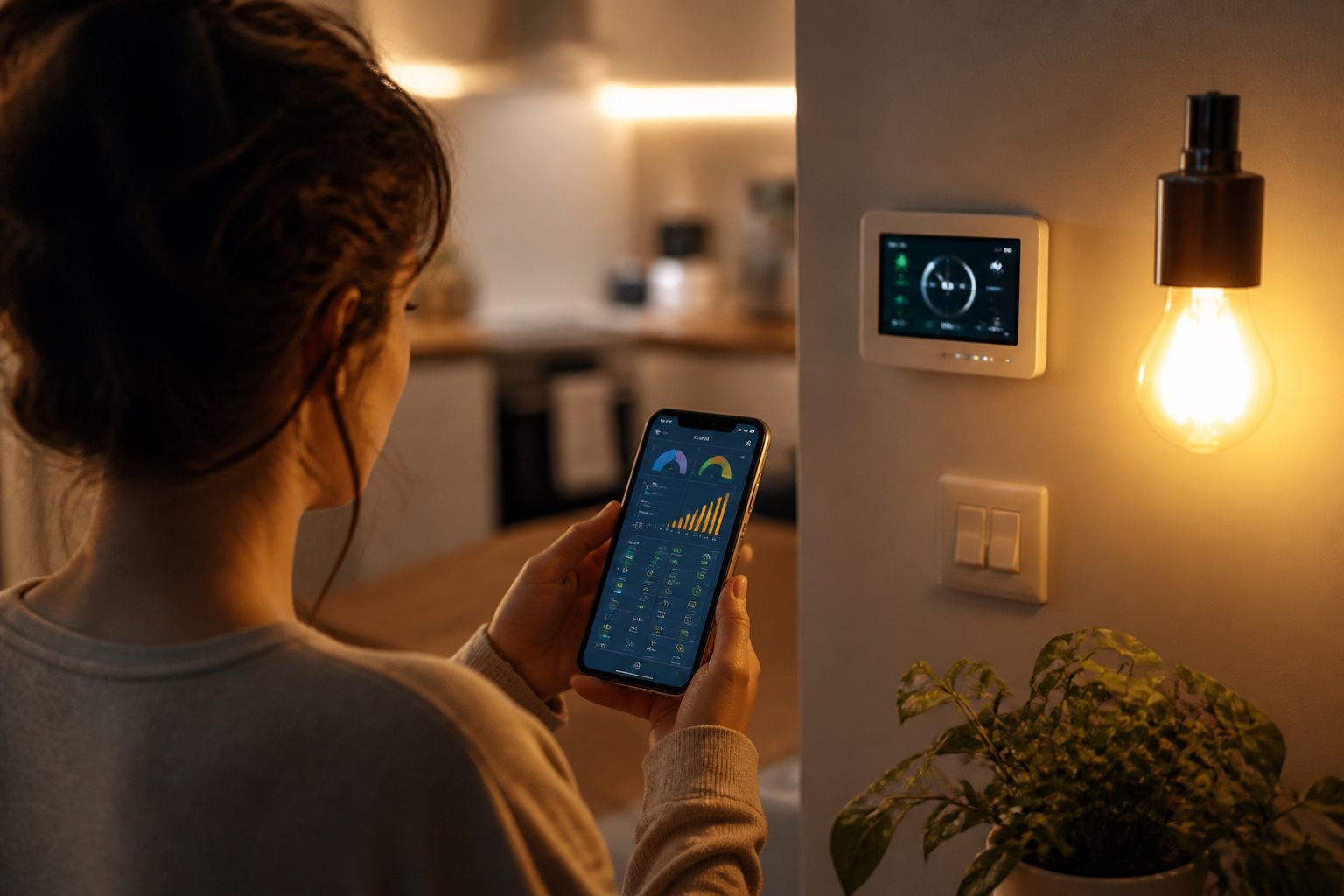
For instance, hallway lights can be programmed to operate only during selected hours, while outdoor lights can follow a schedule appropriate to the household’s needs. Motion sensors may also help in spaces such as garages, storage rooms, and corridors where lights are frequently forgotten. In rooms used throughout the evening, replacing inefficient bulbs with LEDs can reduce electricity consumption without requiring major changes to the home.
Nevertheless, smart lighting should be implemented selectively. Installing connected bulbs in every room may not be cost-effective if lights are used infrequently or already consume very little electricity. Homeowners should first replace inefficient bulbs in frequently used spaces and identify areas where automation can prevent lights from remaining on unnecessarily. Get WizzyDigital.org Blog can complement this process by helping readers explore digital home-management concepts and practical ways to integrate technology into ordinary routines.
Choosing Energy-Efficient Smart Appliances
Connected appliances can provide useful information about electricity consumption, operating schedules, and maintenance needs. Smart washing machines, refrigerators, dishwashers, and other household devices may offer features designed to improve convenience or reduce waste. However, internet connectivity alone does not guarantee better energy efficiency. The appliance’s actual energy performance, operating conditions, and usage frequency remain important factors.
When replacing an older appliance, homeowners should compare energy-efficiency labels, annual consumption estimates where available, capacity, and expected operating costs. A more efficient refrigerator that runs continuously may offer greater long-term value than a connected accessory that saves only a small amount of electricity. In India, consumers can examine applicable BEE star ratings when comparing eligible appliances, while checking that the rating and testing information correspond to the product being purchased.
Smart scheduling can also improve how existing appliances are used. For example, a washing machine may be operated when a suitable electricity tariff is available, provided that the machine supports delayed operation and the schedule does not create safety or convenience problems. Running full, appropriate loads and following manufacturer recommendations can further improve efficiency. These measures focus on meaningful reductions rather than assuming that every new smart device automatically lowers household bills.
Comparing Smart Home Energy-Saving Solutions
Different technologies address different types of energy waste. Before purchasing equipment, homeowners should consider installation costs, compatibility, expected usage, and the amount of electricity the device could realistically help save.
| Smart home solution | Main purpose | Potential benefit | Important consideration |
|---|---|---|---|
| Smart thermostat or AC controller | Manage cooling schedules and settings | Reduces unnecessary cooling | Check compatibility with existing equipment |
| LED smart bulbs | Improve lighting efficiency and control | Uses less electricity than traditional incandescent lighting | Prioritize frequently used lights |
| Smart plugs with energy monitoring | Track and control selected appliances | Identifies consumption and reduces unnecessary operation | Check appliance power ratings and plug compatibility |
| Motion sensors | Automate lights in selected spaces | Prevents lights being left on | Choose appropriate sensor placement |
| Smart energy monitor | Track household electricity use | Helps identify high-consumption periods | Confirm what circuits or appliances it can measure |
| Automated appliance schedules | Manage operating times | Can reduce avoidable operation or shift usage | Savings depend on appliance and tariff conditions |
The table illustrates that no single solution is suitable for every household. Someone who uses air conditioning for many hours each day may benefit more from better cooling controls, while a household with inefficient lighting may see greater value from replacing bulbs. Energy monitoring can help both households determine whether their investments are producing meaningful results.
Using Smart Plugs and Energy Monitors to Find Hidden Waste
Many electrical devices consume power even when they appear to be switched off. This is commonly called standby or vampire power, although the amount varies significantly between products. Televisions, entertainment systems, chargers, networking equipment, and some kitchen appliances may continue drawing electricity when they are not actively being used. Individually, these amounts can be small, but unnecessary consumption across several devices can accumulate over time.
Smart plugs with energy-monitoring capabilities can help homeowners examine the consumption of compatible appliances. By comparing usage patterns, residents can identify devices that remain active for long periods or consume more electricity than expected. A smart plug may also make it possible to schedule power to suitable equipment. However, not every appliance should be disconnected automatically. Refrigerators, medical equipment, security systems, routers needed for connectivity, and devices requiring continuous operation should remain powered according to their requirements.
Energy monitors provide even greater value when homeowners use their readings to make decisions. If an appliance consumes more electricity than expected, the next step may be to adjust its operating schedule, improve maintenance, or replace it when economically sensible. Simply collecting data does not reduce electricity consumption; the savings occur when the information leads to a practical change.
Creating Automated Energy-Saving Routines
Automation allows multiple devices to work together according to a household’s schedule. Instead of controlling each light, fan, and compatible appliance separately, homeowners can create routines for leaving home, returning in the evening, or preparing for bedtime. These routines can reduce forgotten lights, unnecessary cooling, and other forms of avoidable electricity use.
A morning routine, for example, might switch off selected lights after the household leaves. An evening routine could activate appropriate lighting while maintaining cooling only in occupied rooms. A bedtime routine might turn off nonessential lights and entertainment equipment while leaving essential devices operating. The best routines are simple enough to understand and reliable enough to use every day.
Before connecting multiple products, homeowners should check whether they work with the same smart home platform and whether they depend on a stable internet connection. Some automation features operate locally, while others require cloud services. Reliable manual controls are also important, especially when a network outage or software issue interrupts automation. Get WizzyDigital.org Blog can be a starting point for exploring these connected-living ideas, but individual device specifications should always be checked before making a purchase.
Simple Daily Habits That Support Smart Technology
Smart devices work best when they reinforce sensible household habits. Residents can reduce cooling requirements by closing curtains during strong sunlight, improve airflow where appropriate, switch off unnecessary lights, and avoid running appliances when they are not needed. Regularly cleaning air conditioner filters and maintaining refrigerators, fans, and other equipment can also help preserve efficient operation.

Another useful practice is to review electricity consumption regularly. Instead of waiting until the monthly bill arrives, homeowners can compare available meter readings or energy-monitoring data from week to week. If consumption rises unexpectedly, they can investigate changes in weather, appliance usage, occupancy, or equipment performance. Seasonal comparisons are especially useful because cooling needs can change significantly throughout the year.
A few practical actions can help households begin without making the process complicated:
- Replace frequently used inefficient bulbs with suitable LED alternatives.
- Set schedules for compatible air conditioning systems and lighting.
- Measure the electricity consumption of selected appliances where practical.
- Switch off nonessential equipment when it is safe to do so.
- Review electricity usage periodically and adjust routines accordingly.
These steps provide a manageable starting point. Households can add more advanced automation after understanding which changes deliver the greatest benefits.
Understanding Costs, Savings, and Return on Investment
Smart home upgrades involve an initial cost, so it is important to evaluate their potential financial return. A device may be technically impressive but economically unnecessary if it saves very little electricity. Before buying anything, homeowners should estimate how often the relevant appliance operates, how much energy it consumes, and how much of that consumption the proposed upgrade could realistically avoid.
For example, consider a household that replaces a frequently used 60-watt incandescent bulb with a 9-watt LED. If the bulb operates for five hours daily, the estimated electricity saving is 0.255 kilowatt-hours per day. Over 30 days, that equals approximately 7.65 kilowatt-hours. The financial benefit depends on the household’s actual electricity tariff, while the final result may differ because of the specific bulbs and operating conditions.
A similar calculation can help assess smart cooling controls or energy-monitoring equipment. Homeowners should compare the purchase price and installation costs with realistic expected savings, maintenance requirements, and product lifespan. If a device costs more than the electricity savings it is likely to produce during its useful life, it may not be the right investment.
The following calculation can be used to estimate potential electricity savings:
Electricity saved (kWh) = Power reduction (kW) × Hours of reduced operation
To estimate the financial value, multiply the electricity saved by the applicable rate per kilowatt-hour. If electricity prices vary by time of day, the household should use the relevant rates rather than assume that every unit costs the same. These calculations will not predict exact future bills, but they provide a practical way to compare options before spending money.
Protecting Privacy and Security in a Connected Home
Smart home systems introduce additional considerations beyond energy efficiency. Connected devices may collect information about usage patterns, schedules, occupancy, or other household activities. Choosing reputable manufacturers, reviewing privacy settings, and understanding what information a device collects can help residents make informed decisions.
Homeowners should change default passwords, use strong and unique credentials, enable multifactor authentication when available, and install manufacturer-provided security updates. Their home Wi-Fi network should also be protected with a strong password and current security settings. Devices that no longer receive security updates may become less suitable for long-term use, even if their energy-saving features remain functional.
Compatibility and long-term support deserve attention as well. A smart bulb or controller may depend on a particular application, communication standard, or subscription. Before purchasing, consumers should understand whether essential features will continue working if the internet connection fails or a service changes. Energy efficiency should not come at the expense of reliability, privacy, or reasonable control over household equipment.
Building a Long-Term Smart Energy-Saving Plan
A successful energy-saving plan begins with observation rather than immediate spending. Homeowners should review their electricity bills, identify the appliances they use most frequently, and determine which activities account for unnecessary consumption. They can then prioritize low-cost changes before considering larger investments such as smart thermostats, energy monitors, or replacement appliances.
It is helpful to introduce improvements one at a time and measure the results whenever possible. For example, a household might begin by replacing inefficient lighting and adjusting air conditioning schedules. After reviewing its electricity consumption, it could decide whether a smart plug or whole-home energy monitor would provide additional value. This gradual approach makes it easier to understand which changes are working and prevents unnecessary purchases.
Get WizzyDigital.org Blog can support readers who want to explore smart home ideas and practical digital approaches to everyday efficiency. The most valuable outcome, however, comes from applying those ideas consistently. A carefully selected device, supported by sensible routines and regular maintenance, is more likely to deliver lasting benefits than a collection of expensive gadgets without a clear purpose.
Conclusion
Smart home energy saving offers homeowners a practical way to manage electricity use, improve convenience, and work toward lower household bills. Smart lighting, compatible cooling controls, energy-monitoring plugs, efficient appliances, and automated routines can all contribute to better energy management when selected for the right reasons. The amount saved will depend on household consumption, local electricity prices, device efficiency, and how consistently the technology is used.
The best strategy is to begin with the largest sources of avoidable consumption, introduce affordable improvements, and measure the results over time. Homeowners should also consider installation costs, product compatibility, privacy, and long-term reliability before investing in connected equipment. Get WizzyDigital.org Blog can help readers explore ideas for combining technology with everyday home management, while careful research and practical testing can guide individual purchasing decisions.